Polyphot Gmbh, Munich
Bavarian Photo Card Printer & Publisher
Polyphot GmbH, Anstalt für photographischen Maschinendruck, Munich VII, Auerfeldstr. 6.
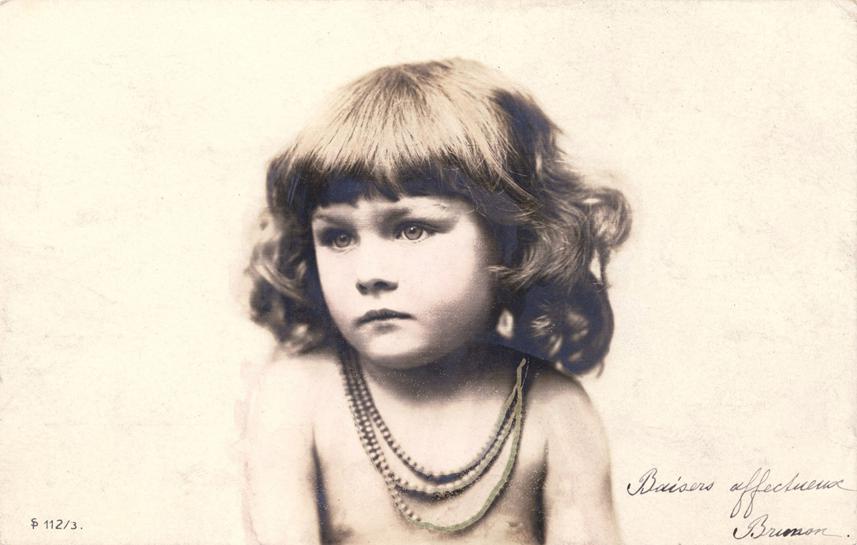
A Bavarian photo paper manufacturer, bromide real photo printer and (postcard) publisher. The origins of the business go back to 1903. The company name read first Photographische Gesellschaft mbH and was found at Rosenheim, a town with a population of some 15,000 people then, about 60 kilometres away from Munich. An important traffic junction.
New Company name and move
Renamed into Polyphot GmbH (business capital 90,000 Marks) in late October 1906. The company moved into a new erected building at Auerfelderstr. 6, Munich. At this place a (demolished then) building erected in 1876 had been the home the regional lunatic asylum. During WW1 years the former Polyphot premises was used as a soup kitchen for the local people.
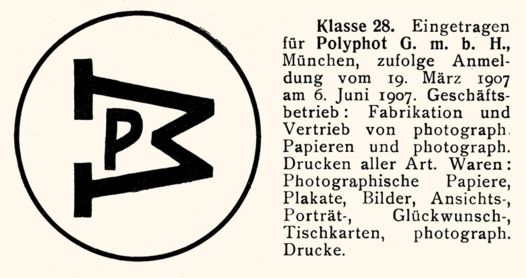
The little bit unusual arranged PM logo was officially registered on 6 June 1907, but might had been used already earlier of course.
Polyphot GmbH was managed by the engineer Anton Fidler together with industrialist Georg Hartmann. Company secretary was a Hans Huebner. Polyphot employed up to 100(+) workers, had a total of some 50 machines for production and was specialised in bromide photo cards, posters and photographic development paper. Including an own letter press printing shop.
Short business History
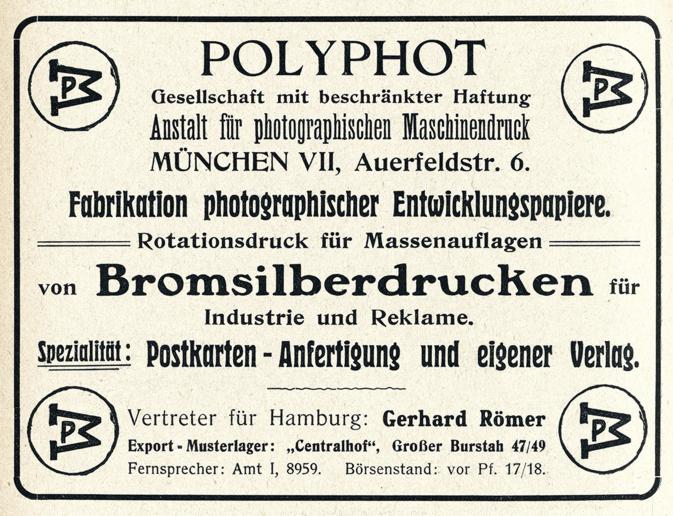
Photographische Gesellschaft worked for Kunstverlag Schlaf from Pasing-Munich (K.S.P.M./"Photographischer Elitedruck" designs) between c. 1904-1906. Other traces lead to customers in France. Polyphot was interested in international markets, with own export agent in Hamburg (see advert).
Then shareholders decided to wind up the Polyphot GmbH business in December 1911. Liquidator was the book-keeper Mathaeus Fuchs. Likely the financial situation had become difficult similar to many other postcard businesses at about the time.
All for Sale
The complete Polyphot GmbH production facilities were offered for sale in March 1912. Among the machines and facilities offered were: a complete photo paper emulsion line made by Aug. Koebig, Radebeul-Dresden, 2 complete developing machines for real photo printing, 4 complete exposing machines, a well equipped photo studio, electric powered flatbed (letter)press and 3 platen presses incl. many fonts, several other presses for various purposes, 2 guillotines, cutting tools, steam engine, electric motors and more.