Hermann Ludewig, Leipzig
Little-known Postcard Printer
Hermann Ludewig, another almost forgotten ppc printer/publisher from the city of Leipzig, is something for the advanced collector interested in ppc printer research. The earliest HL card (p/u Aug. 1900) found comes from a series with colourful views of the Paris 1900 World Exhibition. Many cards (c. pre-1905) printed by Ludewig show name imprinted, usually with process name "Autocolor" together with a tiny 4-digit card number in red ink either on picture or address side.
"Autocolor" was a registered trade (word) mark (class 28) for printer/publisher Hermann Ludewig since 5 December 1900. Registration entered on 13 October 1900. It covered following products: Picture and advertising postcards, posters, calendars, illustrated catalogues, general printing for the trade and travel guides.
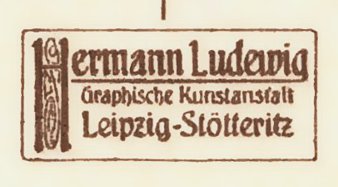
I discovered only a single type of logo yet. Found on Ludewig published cards from WW1 years only (see ill.). Original size 15 x 7 mm, found on an address side of a German WW1 fieldpost card with a street view of the city of Vouziers (France). Monochrome collotype printed, no. 12808, not p/u, c. 1915.
Identification of Ludewig printed cards is only possible with their card number together with some other layout aspects. By the way, the quality of the ‘Autocolor’ (image by halftone, colours superimposed by litho process/3000 cards minimum order) was equal to that of Louis Glaser’s ‘Autochrom’ process. Ludewig cards are sometimes mistaken with the products of local competitor Regel & Krug (‘Heliochrom’), who used also small size card numbers printed in red ink.
Company History
Otto Robert Hermann Ludewig set up his business early January 1900 and although he used lithography process, he appears to have avoided the typical, popular then chromolitho "Greetings from..." cards.
The business was first found at Thalstr. 29. Moved to Riebeckstr. 8, Leipzig-Reudnitz in 1902. Company finally moved into own new erected factory Leipzig-Stoetteritz, Schoenbachstr. 50 on Oct. 29, 1906. From May 1907 on the German postcard publisher (Hermann) Trinks & Co. is found here for some years, too.
Had always wondered how a newly set up printing company was able to produce high-class „Autocolor„ cards from the very beginning. Sufficient capital was one thing. You need a skilled staff and (very) good knowledge of pre-press and printing routines. The profession of Hermann Ludewig before 1900 was stated to be a "Prokurist" (company secretary/authorized signatory). Likely working in local printing trade, but Leipzig was cram-full with printers. Only recently I found the answer. H. Ludewig had been (the only) authorized signatory of big Emil Pinkau company. Pinkau company was set up in October 1873, belongs to the group of earliest ppc printers. Germany‘s biggest postcard printer (exporter) for decades. Ludewig appears to had left his position not long after Paul Etzhold, former director of fine arts printers Kunstanstalt vorm. Etzhold & Kiesling from Leitelshain/Crimmitschau (Saxony), became business partner of Emil Pinkau in March 1899. The company name read now Emil Pinkau & Co. Perhaps Hermann Ludewig even recruited Pinkau employees for his own business. He surely had insider knowledge of the then latest techniques used for ppc printing.
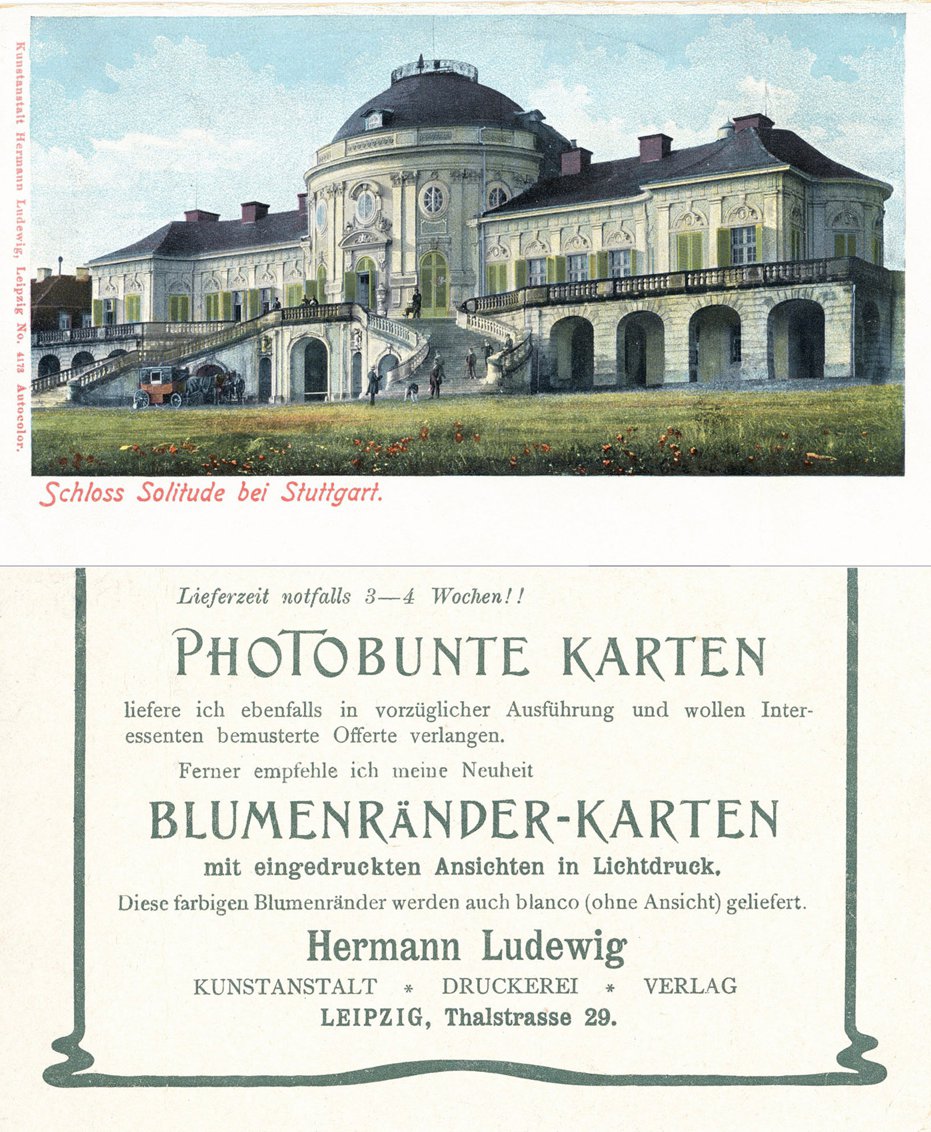
Illustrated is part of an early Ludewig promo folder. "Autocolor" view of a castle near Stuttgart (card no. 4173) on the back. Offered are full colour cards as well as a novelty, a flower frame design with views inserted by collotype process. Available also without imprint. H. Ludewig, Thalstr. = pre-1902 date.
Hermann Ludewig, specialised on picture postcard printing, is said to have employed up to 100 persons. By late 1910 it had dropped to some 60-70 persons. For production they had 2 bigger format letterpress, 6 litho and 2 collotype presses. Plus other machinery. Before 1914 a new (copper) gravure press was installed.
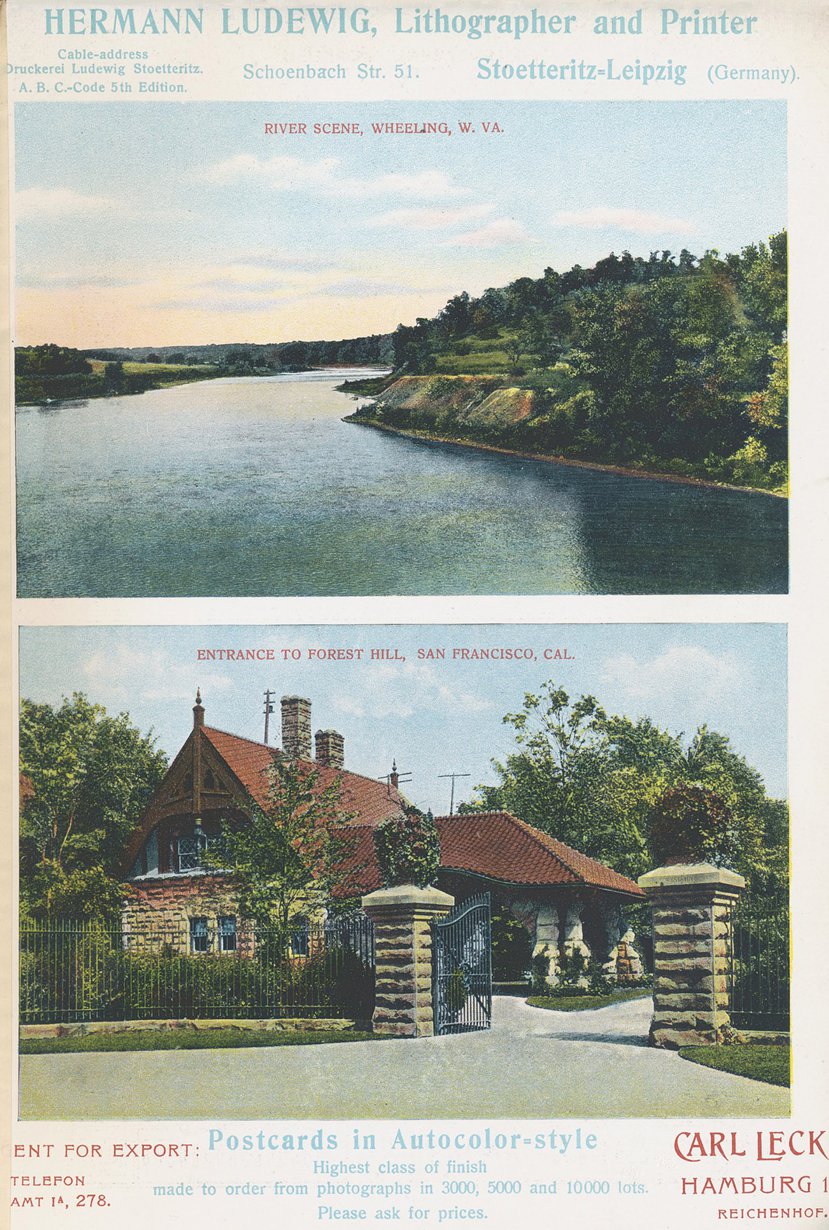
Printed cards for customers worldwide. Good contacts to the USA and also Canada. See Postcard Selection for samples.
In 1924 the H. Ludewig business was taken over by well known local printing company Guenther, Kirstein and Wendler (establ. 1907), owners: Reinhold Wendler and Richard Guenther. GK&W moved to Schoenbachstr. 50 by 1927-28, the former Ludewig business was continued under old name. Both companies with more than 20 various format letterpress, 9 litho and 2 collotype presses and 115-120 workers. Besides picture postcards the company concentrated on catalogue and colour printing in general.
They managed to stay in business during the difficult late 1920’s/early 1930’s, but had to reduce capacity and workforce a great deal. "Ludewig" still listed in Klimsch addressbook 1933 but the 1935 edition lists only ‘Guenther, Kirstein & Wendler’ now. Employed were 77 persons and still with postcard printing among their various specialities.
The company survived WW2 years, always found at same location, suffered dismantling of production facilities/reparations in 1947, but is listed in the 1950 Polygraph Printing Trade directory again with various printing machines and 49 employees. In 1972 transformed into VEB Messedruck, managing director was Doris Guenther.
Ludewig Postcard Identication
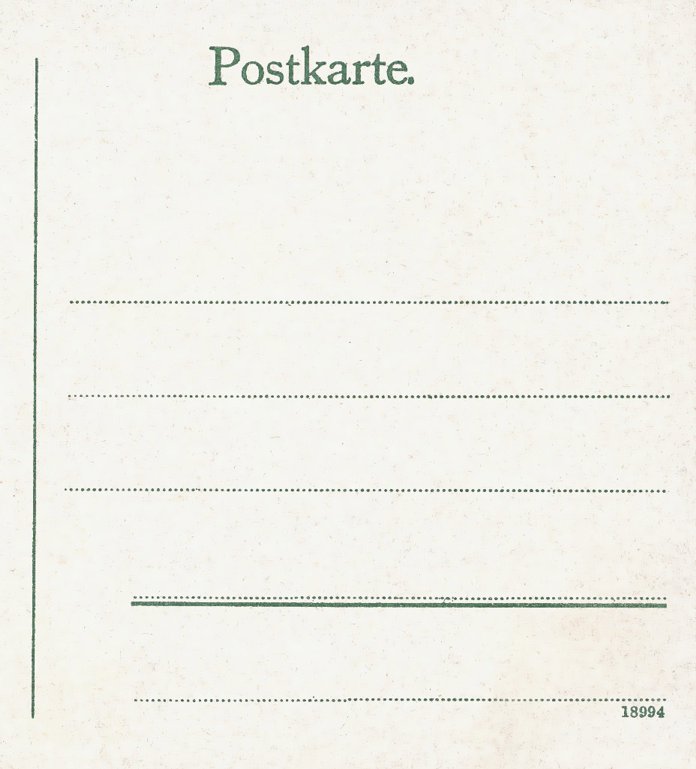
Not an easy task. Early Ludewig cards with name on, either ‘Autocolor’ halftone printed or by collotype process, are mostly of good to excellent quality. Later issues are often typical mass production quality, similar to that of Emil Pinkau.
The only constant identification mark of Ludewig is their small 5-digit card number which appears to be consecutive. BUT this applies to particular makes and also countries prior 1914 only. Normally found at lower right corner position, the address side often printed in green ink. However, there are exceptions. Address side printed in other colour, number found below the writing line but arranged to the left side, or the number rotated, part of lower section of the dividing line, no number at all occasionally, perhaps due to customer requirements. The relatively small, often printed in green ink 5-digit card number was sometimes mistaken with the bigger in size numbers of C.G. Roeder, also from Leipzig.
This is a typical (later) Ludewig address side layout. Three dotted writing lines of equal length for title, name etc. Then the shorter, bolder line for city with dotted line arranged above. Below another dotted line for the street and number at lower right corner position. This scan was worked on to make the thin dotted lines more visible at low resolution.
So far I have seen Ludewig printed (topo) cards from various European countries, USA, Canada and Asia. Plus shipping, social history, WW1 and subject cards. The mentioned small numbers are usually in the 20-30,000 thousand range which puzzles me a little bit. Reprints appear to have received the same card / order number again. As many (later) Ludewig cards are of common nature and quality they might not be of much interest to collectors. For ppc printer research however, Hermann Ludewig company/successor is quite interesting.