|
|
 |
|
|
THE POSTCARD ALBUM
POSTCARD PRINTER & PUBLISHER RESEARCH
|
|
|
|
|
|
|
|
|
|
|
|
|
Similar looking ‘Winsch back type’ designs
|
|
 |
|
|
 |
|
|
|
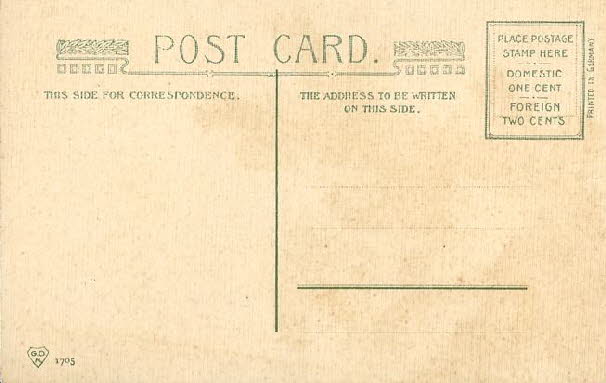
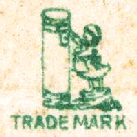
Publishing company ‘Gottschalk, Dreyfuss & Davis’, London, Munich, New York used a similar looking ‘Winsch back’ address side design. Although the differences can be made out quickly. Most GDD cards were printed by ‘Graphia GmbH’ from Munich (story in TPA 25). In the past sometimes believed to be also the source of the “original” Winsch back cards. Although some details are indeed identical and Graphia could supply high quality too, I don’t believe it. – GDD cards show a series number together with “Printed ... or Produced in Germany” imprint and their “Little Girl dropping card into Pillar Box” logo.
|
|
|
|
|
|
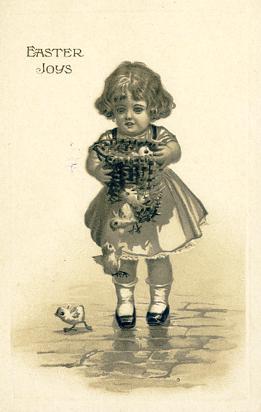
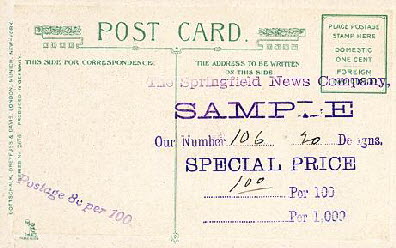
Easter Joys came from GDD series 2676. Old style design, chromolitho, card plate-sunk. Finally available at bargain prices, 100 cards for US $1 plus 8 cents postage from “The Springfield News Co.”
|
|
|
|
|
|
 |
|
|
|
|
The same address side design including floral decorations exactly as on GDD card issues was used by an anonymous US printer, at an later date (?). I have an embossed Christmas card (captions reads Best Christmas Wishes) postally used in 1920, the address side printed in darker grey. “Printed in U.S.A.” and “Series No. 904 / 6” are the only additional imprints.
|
|
|
|
|
|
 |
|
|
|
|
|
|
‘Winsch back type’ Postcard Printer Research
|
|
|
Observations on the topic by the Editor
‘Top Five’ of potential German printing companies who could had been the source
|
|
|
|
|
A tough nut to crack! To identify German printers of US cards is often really difficult. The otherwise helpful comparison of address side details, fonts used, printing quality etc. doesn’t work in many cases. US address side layouts, especially of the greeting card category, simply look different. Unless you find a typical printer code or logo it ends up in speculations. A definite identification requires sample cards with clear mention of printer, alternatively correspondence between publisher and printer.
|
|
|
|
In this case the absence of the officially laid down “Printed in Germany” on many typical Winsch cards puzzles me. I trust the regulation was still effective in post-1910 times. At the present stage of research I understand John Winsch to be an agent only, probably of a bigger art publishing company from nearby New York. This could be an American business with established contacts to bigger German printers. However, it could also be one of the German printers / publishers with own branch office (and stocks) in New York.
|
|
|
|
Although there are no reliable figures of the number of ‘original’ Winsch cards once produced at hand, it appears that we are talking about real quantities. This required a bigger printer with skilled staff and quite some printing capacity. I could name some 30-40 German firms immediately. However, I believe it was an art publisher AND printer, who had established contacts to the U.S.A,, not only customers but with (popular then) artists, distribution network etc. and financially sound. This limits the circle of potential “suspects”. Artists’ work used could probably be a way to reveal the printer identity.
|
|
|
|
|
|
|
|
My “Top Five” were W. Hagelberg AG, Berlin – Lithographisch-artistische Anstalt Muenchen (vormals Gebr. Obpacher) AG, Munich – Albrecht & Meister AG, Berlin – Berlin-Neuroder Kunstanstalten AG, Berlin/Neurode/Dresden and E. Nister, Nuremberg. All five companies would had been in the position to produce the Winsch-back cards.
The answer was suddenly found quickly. It had been “no. 2”: Gebr. Obpacher, Munich.
|
|
|
|
|
There had been strong evidence before that GOM had been the printer, but it requires proofs. Then not just one but several Winsch cards were discovered with the GOM logo found imprinted on address side. Where have these been all the time? Above christmas card (GOM no 1705) was discovered by Russell Eaton, USA. Here it clearly reads ‘Printed in Germany’, which is not always the case.
|
|
|
|
John Butler, USA, kindly provided information showing that John Winsch had worked for The Art Lithographic Publishing Company, New York. That was the name of the US branch of Gebr. Obpacher. This and more details can be found in the Obpacher / Winsch article published in TPA issue 28. Some answers were found, but there is still much left that requires additional research. The earlier unmarked Winsch cards, why there are more and more typical “Winsch back” cards are found with other publisher names on and more.
|
|
|
|
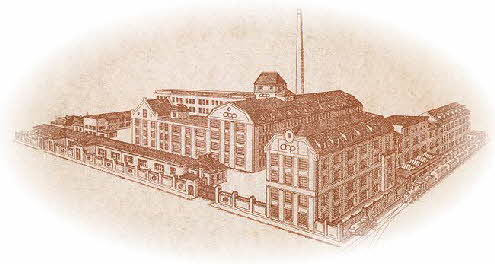
View of the Gebr. Obpacher AG factory, Munich, dating from c. mid 1930’s.
|
|
|
|