Postman

THE POSTCARD ALBUM

POSTCARD PRINTER & PUBLISHER RESEARCH


Regular TPA readers are familiar with this column. As this is read also by newcomers, I am presenting some common, general topics, too. Let’s start with Postcard Novelties. With the ongoing postcard boom, publishers were forced to produce more and more new designs within shorter intervals to meet customers requirements, be ahead of competitors. Furthermore from about 1898 on numerous persons/firms registered (D.R.G.M. in Germany) postcard novelties of various make/material/design. Some ideas made it - but the majority not.

I was told that there had been attempts to compile type lists of old postcards already by the late 1960’s in the U.S.A. Wow. Committed people back then.

Postcard_finds_curio

From photocopies given I learn that these people made up some 10 main categories/sections with a number of subcategories each. Here is an example: Applique Section: Embroidered Cards – Felt or Velvet – Fur-Cloth Cards – Pennant Cards – Pin Cushion Cards – Ribboned Cards – Satin Applique – Satin-Picture Applique – Woven Silk Cards. Interesting stuff. Going to find out more on this. Although I fear I have never seen some of the listed card makes before yet. Never heard of ‘Kleenex Cards’ or ‘Mystery Hinge Cards’, too.

 Postcard sizes and shapes

Some national requirements of the early years resulted in smaller postcard sizes (British court size for example) than the later (UPU) common c. 140 x 90 mm standard.

Clever publishers soon made use of the minimum and maximum sizes allowed to be mailed under postcard postage rate. But that wasn’t all, so-called giant cards were issued. These had to be sent under letter postage rate. The earliest sample I know of is a series of cards published and printed by Knackstedt & Naether, Hamburg, on occasion of the visit of the German emperor to Palestine in 1898. Cards measured 220 x 148 mm.

Another popular postcard novelty were Panorama Cards, usually 2 - 4 regular cards in one piece and fold-out design. They required double postcard postage or letter rate. But there are city panorama cards not as fold-out but in one piece, like the series by Dr. Trenkler & Co, Leipzig. Measurements: 358 x 128 mm and to be mailed under Printed Matter rate. Did they arrive without damage? Well, I believe that postmen surely hated them.

Slim_Lady

More common were smaller designs, sometimes called “micro-cards”. The smallest sizes acceptable for postcard rate was about 75 x 120 mm in Germany according my actual knowledge. Smaller cards had to be mailed as Printed Matter, not only in Germany as some finds show.

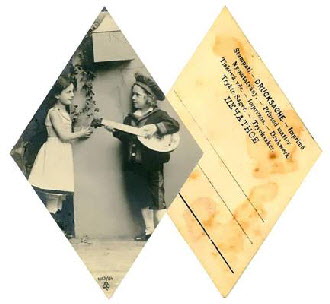
The rhombus shape card illustrated below is among the most unusual designs I have seen so far.

< This is the smallest sized card (sized 42 x 130 mm) I know of which was also postally used. I call it the “Slim Lady” as it bears no caption or any publisher information at all. A real (bromide) photo card, with hardly any room to write message. Mailed in Germany in May 1904 with a 15 Pf postage due mark. With Printed Matter as well Union Postale Universelle imprint.

Gott_nytt_ar

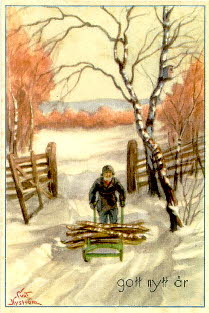
Gott nytt år - winter motif. Card size: 71 x 105 mm. Offset printed in Sweden, not p/u, 1930’s? Later? Signed Curt Nystroem. Published by Axel Eliassons Konstfoerlag A.B., Stockholm.

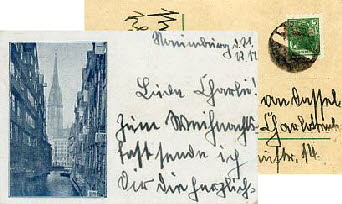
> This is NOT a ‘genuine’ postcard but a ‘Kinderpost’ = post office game for children, item. However, this small card, size 78 x 53 mm, was printed after an original card. It shows a view from Hamburg. It was printed on typical card quality, the image using halftone process. Furthermore some person wrote a message, to a kid I guess, on the card dated 1917. It bears a official looking but small ‘Kinderpost’ postage stamp. No information on the firm who had produced these special items after original postcards. This is the first of this type I have ever seen.

Kinderpost_card_both_sides

> Two kids next to a letterbox. Real photo (bromide) card by a (unknown) publisher who used the initials “S.W.B.” inside clover leaf logo. This firm later be connected with Rotophot, Berlin, somehow The card / series number reads 1483/84. Illustrated are both sides of this unusual postcard design. Sizes: about 130 mm over all, c. 86 mm width

Below: Not really extreme sized but still uncommon was the card size of 148 x 78 mm of a series published by famous Egyptian publishers “Lehnert & Landrock”, Cairo. A series of over 100 views. Illustrated is card no. 92: Port Said - Arrival of a Steamer. All cards I know of show views from Port Said. The photographic printing was done by E. Pinkau, Leipzig. (“Dot & Dash” code), which was used from c. 1926 onwards.

Rhombus_shape_both_sides1
Port_Said_Arrival of a steamer
[Home] [Postcard History] [Identification] [Printer Logo's] [TPA Magazine] [Contact] [PPC Novelties] [Why cardboard?] [Finds & Curio] [Collecting Subjets]